
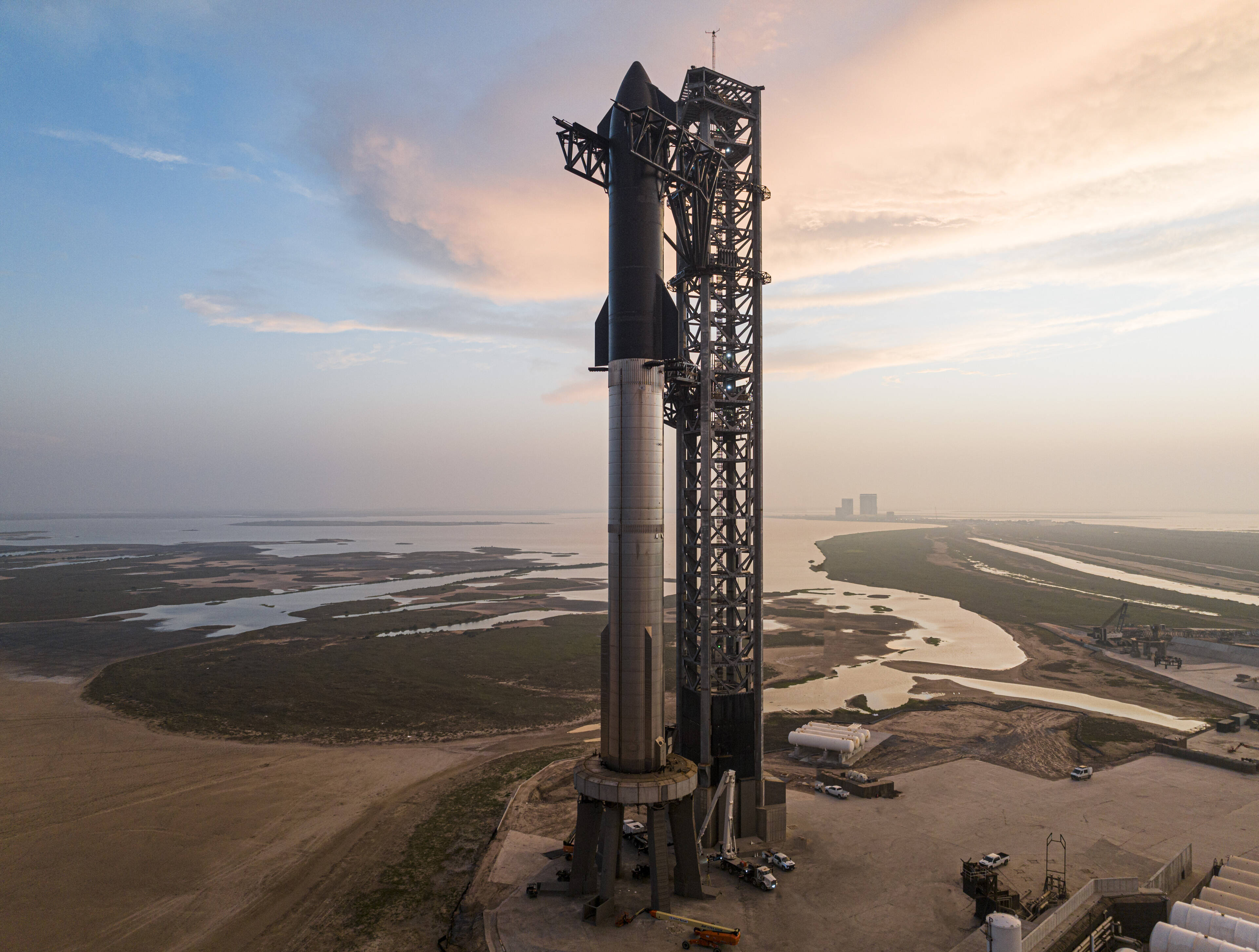
Credit: SpaceX
Anticipation
I’m currently sat at my desk trying to fill the time between now and the 8th test flight of SpaceX’s Starship in a few hours time. I wanted to talk about the flight this week, but after a little thinking I’ve come to realise that the regulars on this site are after some accessible information that can give them an introduction to spaceflight concepts and technology.
With this in mind, I’d like to start a new series of articles that give the average person a rundown on different rockets, historical or current, that have shaped humanity’s foray into the stars. It’s only fitting that I start with a rocket that has, I would argue, the largest public profile as of writing.
Whatever you think about Elon Musk, SpaceX and Starship are here to stay, so let’s break down the rocket and see what my personal opinion on it is.
The Bottleneck
In order to understand why Starship generates such fervour online whenever a test flight is coming up, we need to look at what it does differently to previous rocket designs.
Ever since we started launching things into space, rockets have been single use. Millions of dollars or roubles (other currencies are available) would be spent building rockets, only for them to launch and be completely unusable after their first and only flight. This expendability is due to a technique that orbital rockets use to improve efficiency.
Staging, as it is known, is the process by which a rocket discards fuel tanks and engines in order to shed excess weight and improve the efficiency of the overall vehicle.

The Saturn V rocket discarding the first stage during its launch to space. | Credit: NASA
Due to the physics of launching rockets (more specifically the Tsiolkovsky rocket equation), launching payloads into space using a single, one-stage rocket is extremely inefficient. In essence, a rocket is attempting to fight the force of gravity, and any mass that isn’t shed during the ascent in the form of fuel consumption has to be carried with the rocket on the way up. This means the rocket has to do more work to carry the same payload into orbit, as it is also carrying all of the empty fuel tanks and hardware necessary for the initial launch.
A multi-stage rocket avoids this problem by incorporating multiple sections into the design which fall away as the rocket ascends. This has the added benefit of allowing engineers to design engines that are optimised for different altitudes, as different air pressures require different engine designs for optimal efficiency. Of course, the downside for this is that all of the stages are left to fall back to Earth and subsequently be destroyed either by an impact with the ground, or by water damage should a splashdown be the fate of a particular stage.
Ultimately, this is part of why spaceflight is so expensive. It’s like having to build a new airliner every time you want to go on holiday. The costs would make air travel extraordinarily expensive, and the same is true for spaceflight.
Starship aims to change this.
Stage 1: Super Heavy

Super Heavy first stage performing a static fire test. | Credit: SpaceX
Starship’s first stage, dubbed Super Heavy, is one half of the solution to the expendable rocket problem. An evolution on the technology pioneered by SpaceX’s Falcon 9 rocket, the Super Heavy first stage aims to become re-usable by returning to the launch pad after boosting the second stage to a sufficient speed and altitude.
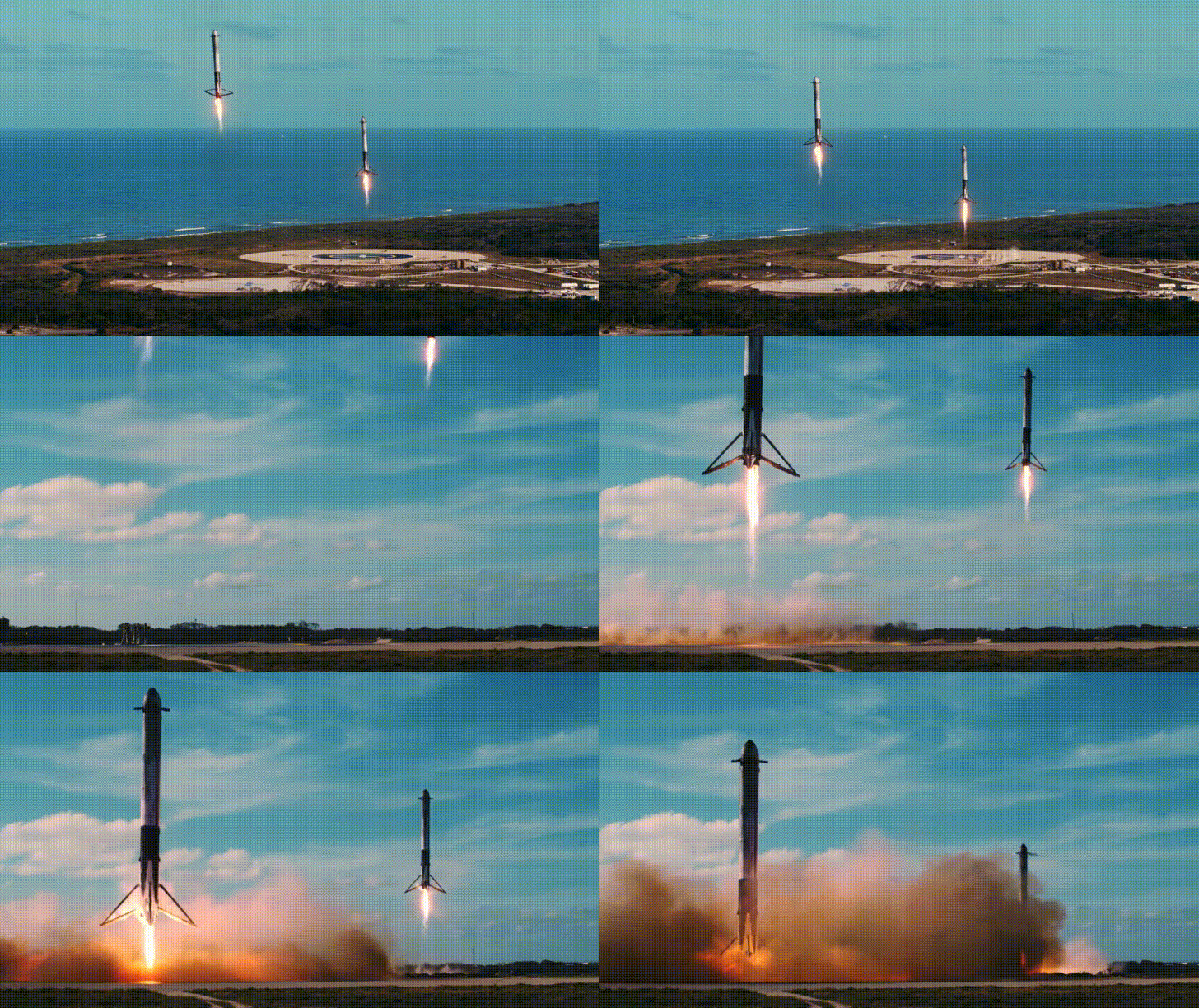
Falcon Heavy boosters landing at Kennedy Space Centre. This technology would pave the way for Starship’s Super Heavy first stage. | Credit: SpaceX
Unlike the Falcon 9 before it, Super Heavy will not incorporate landing legs into its design. In order to arrest its descent, it will instead be caught by the launch tower, which features two large arms that pinch it out of the sky. This saves weight on Super Heavy by incorporating all the necessary technology that would have been in the landing legs into the launch tower instead, giving Starship more fuel margin overall.
While this sounds like a concept that borders on science fiction, SpaceX has already demonstrated this capability on two previous test flights of Starship, meaning that the recovery and re-use of the Super Heavy in this manner is feasible.
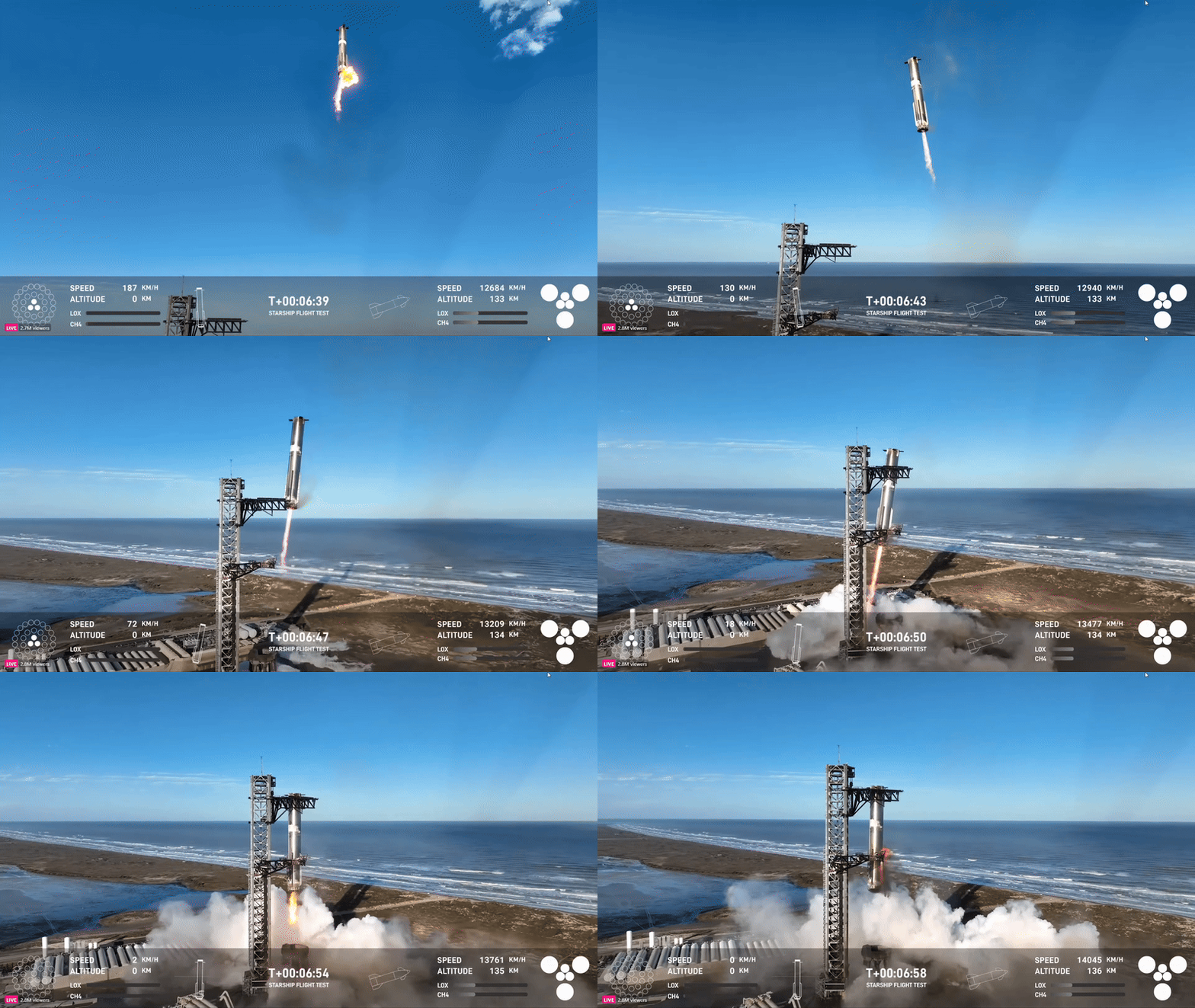
Super Heavy being caught by the launch tower. | Credit: SpaceX
While on the topic of Super Heavy, it’s also worth discussing the engines it uses.
The Raptor engines are used throughout the entire Starship design, and are also paving the way for the next generation of rocket technology. Utilising a complex but efficient architecture, Raptor aims to squeeze every possible bit of performance out of a rocket engine. It aims to achieve this goal utilising what is known as a full flow staged combustion cycle. This essentially describes how the fuels in the engine are burned in two stages, in equal parts, so that the pumps can be driven and that the fuels enter the main combustion chamber of the engine as a gas, making the overall combustion more efficient.
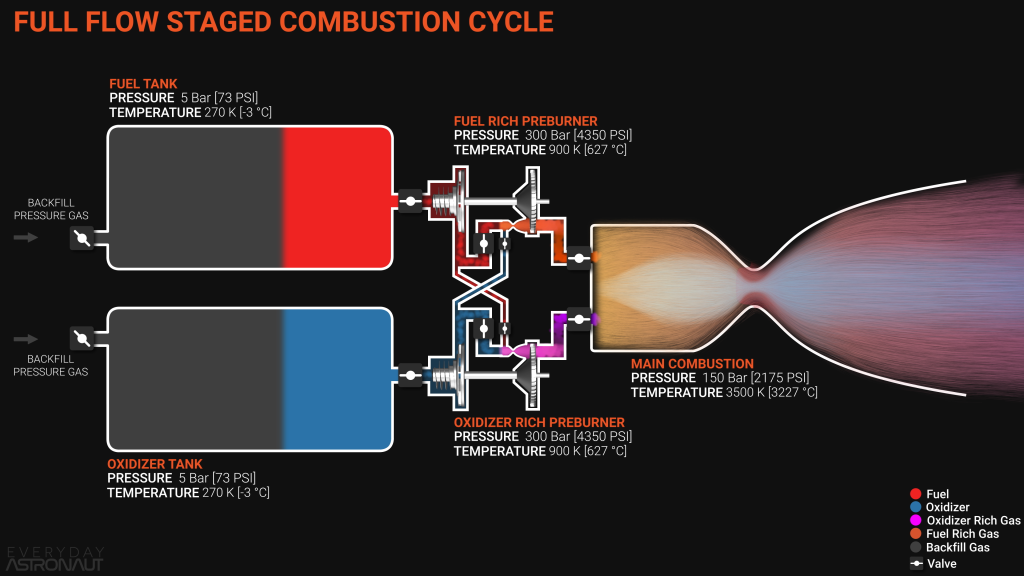
A diagram showing the full flow staged combustion cycle engine concept. | Credit: Everyday Astronaut
Starship requires such efficient engines so that it can maximise the payload capacity of its second stage, which will have to carry more mass than a typical upper stage would. To understand why, we can move onto…
Stage 2: Starship

Starship Version 2 upper stage. | Credit: SpaceX
Rather confusingly, stage 2 of Starship is also known as, well, Starship. For reference, I will use the Starship moniker to refer to the upper stage only during this section.
The second half of the solution to the expendable rocket problem, Starship aims to rethink how spacecraft can return to Earth and be re-used. By engineering a new solution to from-orbit stage recovery, Starship may achieve more rapid re-use than the likes of the Space Shuttle or X-37, which both utilise(d) a spaceplane concept.
The main problems faced by the aforementioned spaceplanes that Starship aims to improve upon involve the method of recovery and the design of the heat shield.
Firstly, the method of recovery. Both the Space Shuttle and X-37, as you may have guessed from the spaceplane concept, utilise(d) a runway to land back on Earth. This has a few restrictions on the logistics of re-using a spacecraft. Primarily, runways are space inefficient, and take up a lot of land to construct. Indeed, the Space Shuttle only ever utilised 3 different runways during its service as it was only capable of landing at a select few around the world. Other logistical challenges involve making the vehicle safe to approach after landing, and getting the vehicle to a place where it can be inspected and refurbished.
Refurbishment in particular was important for the Space Shuttle. As mentioned above, the heat shield in particular posed a significant challenge to the Space Shuttle’s operation, and it was closely inspected and refurbished after every flight. Each thermal tile of the Space Shuttle was unique, so manufacturing the desired replacements was costly; specialised equipment was needed to create the right shape for each tile.
The Starship upper stage aims to rectify both of the challenges presented above.

A section of the Space Shuttle’s thermal tiles, used to protect the spacecraft from re-entry heat. | Credit: NASA
In order to simplify and improve the logistical aspects regarding re-usability, Starship, much like Super Heavy, aims to be caught by the tower back at the launch pad. This presents a number of benefits, such as being able to conduct a visual inspection of the heat shield without having to lift the vehicle off a runway. Additionally, should the vehicle be in a safe condition to re-fly with little to no work needed, it is already on the launch tower and can be stacked onto another Super Heavy booster for another flight. For a little more detail about how Starship will re-enter and land, you can read this article!
In the event that the Starship heat shield needs refurbishment, its simplified design compared to the Space Shuttle gives it a potentially shorter turnaround time. By utilising a mostly uniform tile layout, the Starship heat shield aims to make any repairs a simple task of replacing the necessary tiles with mass manufactured duplicates. A significantly reduced number of special tile shapes means the manufacturing process can be simplified and made cheaper, and also makes the necessary repairs less complex.

Starship’s largely uniform thermal tiles. | Credit: Reginald Mathalone
The Future of Spaceflight?
Time for the opinion bit.
Personally, I am a Starship optimist. I really believe in the engineers at SpaceX, and their track record for accomplishing industry firsts is my main reason for optimism. For me, Starship is the most exciting project in spaceflight and holds immense potential to fundamentally change space travel as we know it.
My main concern with the Starship design is making the heat shield robust enough for a rapidly re-usable system. The Space Shuttle demonstrated the myriad of challenges that thermal tiles present as a technology, and I remain the most apprehensive about this element.
That being said, SpaceX are currently testing many different types of protection for Starship, and they may decide to change to something completely different should these tests present an alternative solution.
Finally, the cadence of launches that the test flight program has demonstrated thus far has boosted my confidence. SpaceX continue to pump out test flights as part of their iterative design approach to rocket development, and seeing it all in action live is something that excites me like nothing else.
I hope you understand Starship a little better, and I hope you tune in for future test flights. I know I will!
See you next week!


Leave a reply to Space Race II: Electric Boogaloo. A Look at the Competitors. – Weekly Voyager Cancel reply