
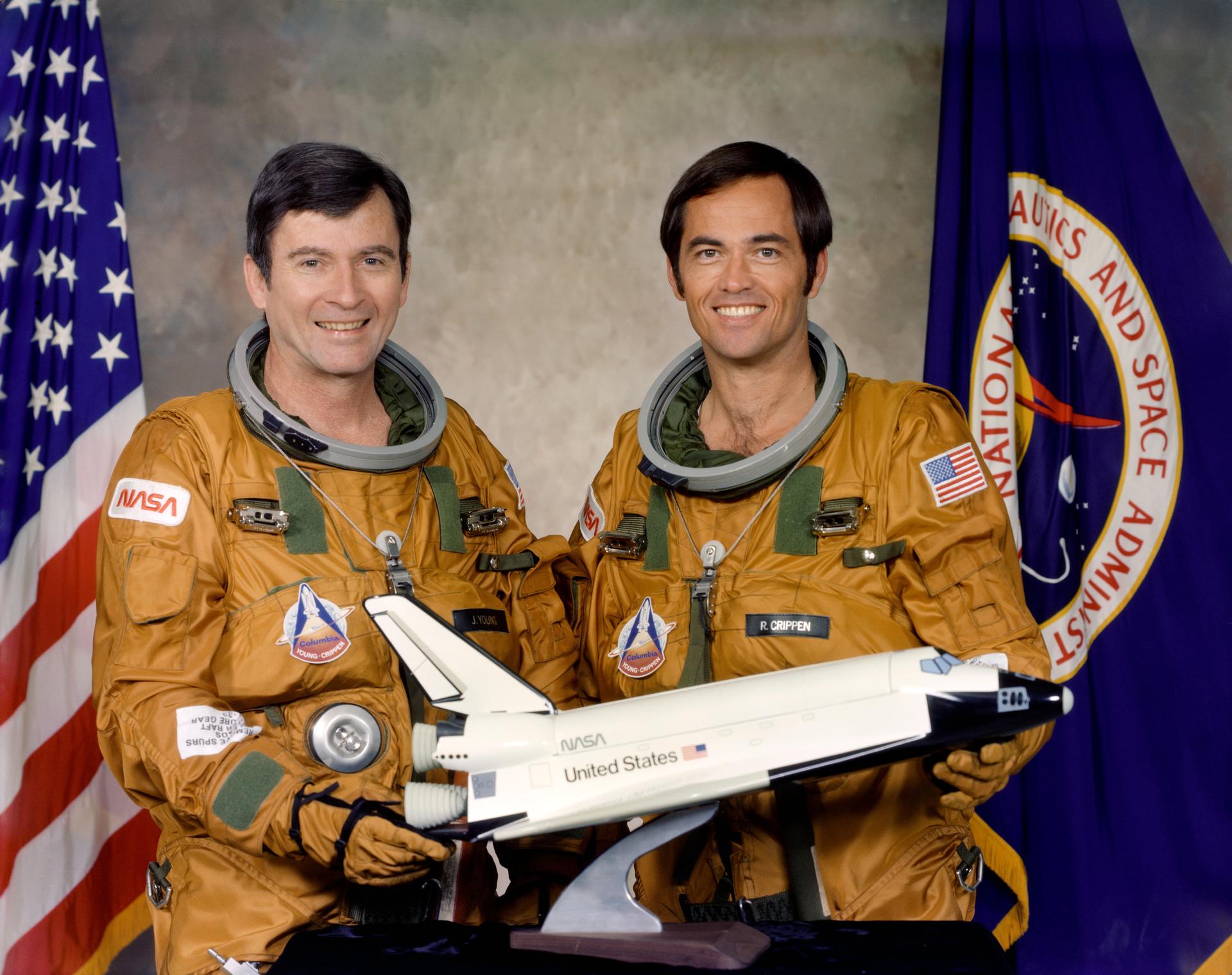
John Young and Robert Crippen. | Credit: NASA
Reflecting on the Shuttle Program
The Space Shuttle is, in my mind, the only spacecraft to really pierce the public consciousness. It is the default vehicle for sending people to space in all manner of media, even over a decade after its retirement. Movies like Don’t Look Up, Gravity and even Pixar’s Cars feature the Shuttle in some form or another.
While undeniably iconic, the Space Shuttle’s real history is without a doubt worthy of its own blockbuster. From development, to disaster, to daring return, this multi-generational icon is responsible for some of the most heroic and heart-breaking tales in spaceflight’s storied past.
As I write this (February 1st 2025), the day is winding down, and I am left to reflect on the anniversary of Columbia’s tragic final flight. STS-107 (Shuttle missions are designated STS-X) met a pre-emptive end on this date 22 years ago, burning up on re-entry due to damage sustained on the leading edge of the left wing. 7 astronauts were ultimately killed, and the Space Shuttle faced retirement. After debates over cost and age, it was the fact that it claimed 14 lives over its service that made the Shuttle unfit for the 21st century.
On 21st July 2011, Kennedy Space Centre welcomed the world’s most advanced flying machine back to Earth for the last time.
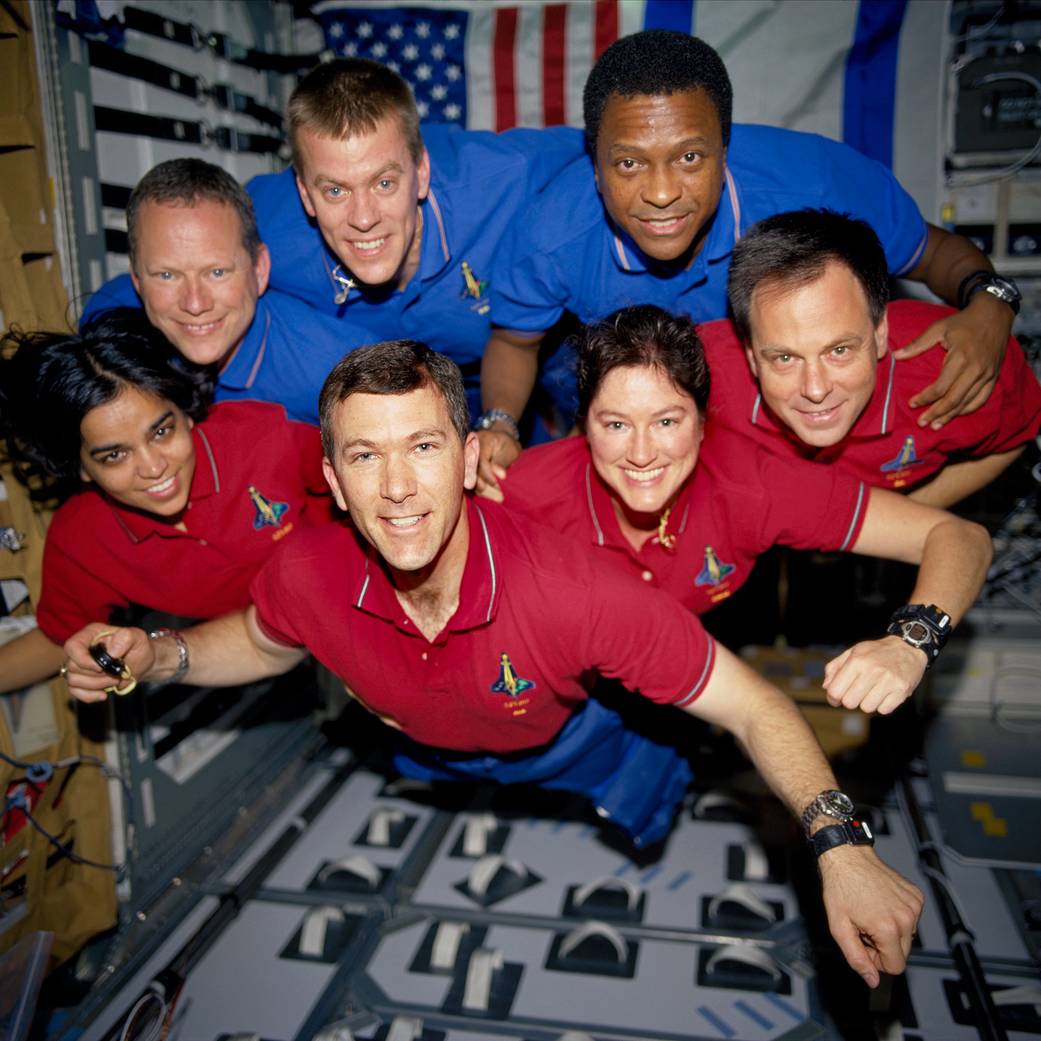
The crew of STS-107 in orbit. | Credit: NASA
Despite living an ocean away and a generation apart from the Shuttle’s best years, it’s hard for me to not love it, even with all its difficult history. For me, the Shuttle represents the first baby step towards making humanity a truly space-faring species. Vostok put the first man in space, Apollo landed men on another celestial body, but the Shuttle, to me at least, was the first true “spaceship.” The Shuttle could take a crew to space, deploy cargo, dock to space stations and do scientific experiments in a capacity unrivalled by any other spacecraft before or since.
Naturally, the people who dared to imagine such a vehicle, the people who built such a vehicle and the people who flew such a vehicle are inspiring to me, but John Young and Robert Crippen, the Shuttle’s first crew, are bona-fide heroes in my books.
The Right Stuff
It’s a cliché amongst spaceflight fans at this point, but it’s hard to find any other way to describe it. Those two men at the top of the page had the right stuff. They were mentally resilient, extremely intelligent and physically capable for the job they were given. Some might even say they were born to be astronauts.
Robert Crippen might not have believed you if you told him he’d be flying in space after June 1969. Originally a USAF (US Air Force) astronaut, Crippen transferred to NASA in 1969 after the program he was slated to fly with, the Manned Orbiting Laboratory, was cancelled. His experience in computing was put to use on the Space Shuttle’s development, and he was primarily in charge of these very computers on his first spaceflight aboard the experimental vehicle.
John Young, by contrast, had nothing to prove by the time he was selected for the Shuttle’s first flight. A man I consider to be the world’s first true space explorer, Young had completed two Gemini flights and two trips to the Moon (walking upon its surface the second time around, for good measure…) before being selected for the Shuttle’s first flight. Not having Young sit in that second seat just seems wrong when you look at his starry resume.

Young and Crippen training. | Credit: NASA
Astronauts on the First Test?
While each and every detail of the Shuttle was combed over, and every component tested and re-tested, the first flight of the Space Shuttle would indeed bring humans along for the ride.
Testing a rocket and spacecraft combination the likes of which the world had never seen, for the first time, seems like the sort of thing you wouldn’t want to put humans anywhere near. NASA however, had a legitimate reason. While the Space Shuttle, contrary to popular belief, could actually land itself, the capability was largely untested. As such, the risk to the public on the ground was too great. Having astronauts on board who could manually fly the Shuttle in case of any problems was really the only way to mitigate this problem, and so it was.
This, then, is NASA’s test flight gamble. Two men’s lives hung in the balance so that the public at large could remain safe from potential harm. A spacecraft that would launch, fly and land like no other before it would complete its first ever full test flight with two of NASA’s greatest assets on board.
If you thought that Crippen or Young might have been a bit bothered by this, I wouldn’t worry. Young is famously calm during launches, and during the launch of the test flight (STS-1), his heart rate peaked at 90 BPM (A normal heart rate is between 60-100 BPM at rest). When quizzed about this after the fact, Young said:
“I want it [his heart] to go faster, but it won’t.”
These two men were willing to put themselves in harms way, literally flying into the unknown, for the benefit of human knowledge and technological advancement. Both men were married and had children. They had everything to lose. It cannot be overstated how incredibly brilliant it is that they willingly chose this mission, and executed their duties to the standard that they did.

The external tank after staging during STS-1. | Credit: NASA
Going Bust?
NASA’s gamble with STS-1 was much closer to disaster than they would have known before, and even during the flight. Only after Space Shuttle Columbia touched down, and a post-flight analysis was conducted, was everyone aware of just how close they came.
During the ascent, some white tiles designed to protect the spacecraft from thermal radiation in space came loose. While NASA concluded that this damage was not serious, losing tiles would become a recurring problem during the Shuttle’s lifetime. It would be the subject of controversy after Space Shuttle Atlantis was damaged on re-entry during STS-27, due to black thermal protection tiles coming loose.
The main damage sustained during STS-1 was not known until landing, and was significant enough that John Young later remarked that the damage had the potential to make re-entry “extremely difficult if not impossible.” Needless to say, the inability to re-enter Earth’s atmosphere safely has deadly consequences. This damage related to a key part of the Shuttle’s control system: The body flap.
Much like a passenger aircraft, the Shuttle had various control surfaces that allowed it to pitch, yaw and roll like a plane during atmospheric flight. During re-entry however, it needed something else that is unique to its design. An additional control surface, called the body flap, was added into the design underneath the ascent engines, to allow the Shuttle to control its pitch during re-entry.

Passenger planes use control surfaces such as these to direct the plane, and control the amount of lift generated. | Credit: prahatravel

The body flap of the Space Shuttle. Like the control surfaces of a plane, this points up and down to help direct the Shuttle during re-entry. | Credit: @CaptainBJones
During the launch of STS-1, shockwaves generated by the thrust of the engines damaged the body flap, bending it into an angle beyond which severe damage to the hydraulic systems was expected. Hydraulic systems use fluid pressure to move the control surfaces on the Shuttle, including the body flap. If this system was ruptured, the astronauts could not have returned to Earth safely, and there were no rescue options to fall back on. It is remarkable that the systems continued to work beyond the point at which breakage was expected.
A number of other issues were also identified upon return, some of which also presented potentially fatal dangers to the crew of STS-1. Fuel tank supports failing, calculation errors and buckling landing gear doors are a sampling of some of the other problems that were identified in the post-flight analysis.
Growing Pains
In the end, the gamble paid off. NASA proved to the world that America was still at the forefront of space exploration, and that access to space was becoming, they hoped, routine.
STS-1’s issues were discovered, and fixes were implemented in time for flight 2. It’s easy to overlook just how close Crippen and Young came to a one way trip on this mission. With all the other tragic and triumphant tales that the Shuttle program is associated with, the details of STS-1 are often overlooked. Pride and prestige are what I believe most people take away from this flight.

Robert Crippen disembarks Columbia after touchdown. | Credit: NASA
I think, despite the close calls, there’s still something romantic about STS-1. Two all-American test pilots, strapped into a new flying machine, reaching the final frontier in a spacecraft that just about makes it home in the end.
I think the 1980’s having a banger soundtrack helps too.
See you next week!
 Weekly Voyager
Leave a comment