

An ASK-21 glider. | Credit: me!
I’ve been away for a little while…
During my absence from this website, I have finally taken up a hobby that fulfils one of my long time ambitions (that being flight). It should come as little surprise to many of you that I’d have such a goal, seeing as the website I run is solely centred around aerospace technology.
I have had the immense privilege to fly gliders for the past few months, and my development as a competent and responsible pilot has, thus far, been consistent and rewarding. Each lesson feels like a step forwards, and I have surprised myself at how quickly I have taken the reins during my lessons. I feel very confident that I will accomplish my first solo flight in a reasonable time frame, which is a testament to the excellence of all the instructors at my local club.
One other thing that astonished me was how comfortable I was communicating with other club members about the mechanics of flight and the designs of aircraft. I realised during these discussions that a lot of my knowledge had, in fact, come from my experiences playing various simulator games like Kerbal Space Program or Microsoft Flight Simulator.
I sincerely believe that a case can be made for videogames imparting transferrable skills upon a user, and so this article will make this argument in the context of piloting.
Coordination is King

Following the tow is an exercise in coordination. | Credit: me!
The fact that some degree of hand-eye coordination is required for skilled piloting should not be surprising to anyone. Operating a car, crane, boat or plane is a task that requires the user to operate their hands and eyes independently, with one’s vision informing their inputs.
The same thing is true for videogames.
Those of us that play for hours at a time may take it for granted, but the ease at which we play all these modern games, with complex, three dimensional motion, is ultimately a skill that is developed. Handing the controller to those uninitiated in the art of videogaming will make this extremely apparent.
If any of you have had the joy (or frustration) of watching someone play videogames for the first time, you’ll understand what I’m getting at. Slow, clumsy movement. Always looking at the floor. Unable to move the camera and character independently.
It’s almost like watching a toddler learn to walk.
Ultimately, playing videogames builds up one’s ability to operate a series of complex controls with little conscious thought, allowing the user to focus their cognition on the more abstract elements of the game, such as strategy and resource management. Many of those who play games will also know that these skills are transferrable to a variety of control mediums; being good on one type of controller typically means that you’ll more readily adapt to another type when compared to someone who is not as experienced overall.
“There’s too many buttons!” – Every parent ever.
Indeed, it would appear that the coordination acquired from playing videogames is finding use in warfare. According to Business Insider, the Ukrainian army is finding gamers to be quite adept at piloting drones, with one drone unit commander saying:
“They already have experience […] controlling complex systems, which are all important skills in combat.”
Decisions, Decisions….
As mentioned, videogames typically require planning and decision making skills. A multitude of genres challenge an individual on these skills in different ways. Games like Factorio test one’s ability to plan complex systems and manage resources. Success in the Total War franchise is dependent on strategic skills. Eve Online presents more economically minded players with the ultimate spreadsheet experience.
The ability of videogames to impart upon the user some of these skills has not gone unnoticed. Speaking to Invest Like the Best, Tobias Lütke, Shopify CEO, says of Factorio:
“Part of Shopify is building warehouses and fulfilling products for our customers. We are building global supply chains, which is six networks, and Factorio is kind of something that makes a game out of that kind of thinking.”

Shopify CEO Tobias Lütke allows staff to write-off their purchases of Factorio as a business expense. | Credit: Vonderchicken
How does this relate to gliding?
One way to see gliding is as a resource management problem. Altitude is ultimately a resource than can be spent in different ways during a glide. By “spending” altitude in the form of a higher airspeed, you can minimise time in areas of high sink. On the flipside, maintaining an optimal glide (“spending” less altitude) can increase your overall glide distance.
On-the-fly planning (pun intended) also relates to the path that a glider pilot may take to reach his/her desired destination. Identifying potential areas of thermal activity (rising air) and generating a route that allows one to take advantage of all these opportunities is a vital skill for a glider pilot.
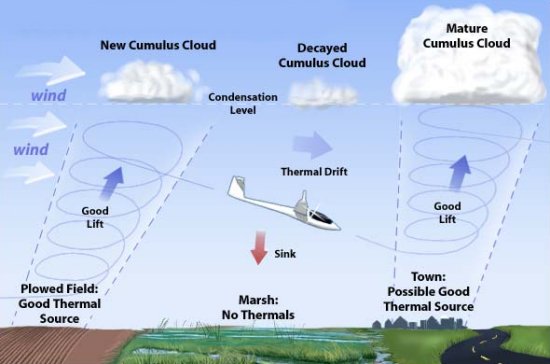
Recognising thermal sources allow pilots to plan routes through the sky. | Credit: Aerospaceweb.org
Transferrable skills that can be acquired from playing games centred around planning and strategy may provide a benefit to would-be pilots, as they are more accustomed to making complex decisions under a time pressure that may not manifest itself in their day-to-day lives.
Some scientific research backs up this idea. According to a study for Neuroimage: Reports, videogame playing may have a positive effect on decision making skills. The researchers state that:
“Video game playing potentially enhances several of the subprocesses for sensation, perception and mapping to action to improve decision-making skills.”
The Obvious
One last, more obvious way that videogames could help one become a better pilot is via the use of flight simulators. In fact, my own local club has their own flight simulator for the rainy season.
Using games like Microsoft Flight Simulator (or Condor for gliding) facilitates more direct training methods. Reinforcing checklists and behaviours in a virtual environment can help a pilot more quickly memorise important, safety critical items that would otherwise take longer to internalise.
I myself have practiced some key concepts in simulator games. Examples include lookout procedures, pre-flight checklists (CB SIFT BEC for those who know…) and radio callouts. Reinforcing these behaviours ensures that I glide safely and responsibly.

Condor provides the most realistic gliding experience on PC. | Credit: condorsoaring.com
Simulated instruments can also be useful for trainees, as it allows them to familiarise themselves with the information being fed to them in a safe and controlled environment. My first time sat in a glider felt more familiar than it would have without any simulator experience as I already recognised many of the instruments that were in front of me.
Thoughts?
The benefits of gaming can be a controversial topic, so I would love to know your opinion on this matter. I hope I have made a compelling case for the potential benefits. Of course, not all games are created equal. A diet of nothing but Call of Duty may not be as beneficial in terms of transferrable skills when compared to other types of games.
Regardless, I’m sure there’s plenty more to discuss, so feel free to comment on this article or reach out via my profile!
 Weekly Voyager
Leave a comment