

Apollo 12 launching in stormy weather. The Saturn V rocket would be struck by lightning during the ascent, causing electrical malfunctions. | Credit: NASA
It Goes Without Saying…
Rocketry is an inherently risky business. It should come as no surprise when your vehicle’s method of propulsion amounts to a controlled explosion, after all.
That being said, rockets can fail in an innumerable number of ways, with many famous cases documented in the annals of spaceflight history. Indeed, the Challenger and Columbia disasters are the most painful to recollect, at least to me.
Fortunately for some, however, outright disaster is narrowly averted. This week I aim to present a triad of these nail-biting near-misses in the hopes that one can better appreciate the perils faced by all space-farers.
Soyuz MS-10

Soyuz MS-10 launching from Baikonur. | Credit: NASA
We’ll start with a near-miss that sits in living memory for, I would hope, everyone reading this article.
11th October 2018 was set to be the day that Aleksey Ovchinin returned to space for his second trip. Nick Hague, on the contrary, would be earning his wings aboard his first spaceflight. Both cosmonaut and astronaut respectively had full confidence in their Soyuz spacecraft, and for good reason.
MS-10 would mark the 139th flight of the Soyuz, and many more for the R-7 rocket family from which the modern launch vehicle is derived. With only a handful of failures over decades of faithful service, all seemed routine. For those who work on such rockets, it probably was.
What certainly wasn’t routine was the explosive failure of the rocket, occurring only a couple of minutes after its rapid ascent over Baikonur Cosmodrome. Fortunately, the safety mechanisms aboard pulled the crew free of this accident and both returned in good health.
The Soyuz rocket utilizes a core stage with four radially mounted boosters that generate additional thrust during the first few minutes of the ascent. Upon fuel depletion, these boosters separate from the core stage in what has become a rather iconic scene for spaceflight fans.
During Soyuz MS-10, booster separation became the cause of a multimillion rouble RUD (rapid unscheduled disassembly). Videos of the incident show a violent collision and subsequent explosion that was ultimately attributed to one of the booster stages failing to separate cleanly.

Soyuz MS-10 breaking up after a staging malfunction. | Credit: Roscosmos
It is a testament to the Soyuz design that the crew survived unscathed. Having only been triggered once before on the ground in 1983, the launch escape system proved its worth during flight conditions; pulling the duo free and returning them to Earth on an uncomfortable, but safe, ride.
Launch escape systems provide an extra layer of safety in the event of a failure such as Soyuz MS-10. What happens if you have no choice but to ride out a problem?
STS-93

The crew of STS-93. | Credit: NASA
It’s the 23rd of July 1999. A new millennium is around the corner and the world’s most advanced flying machine, the Space Shuttle, is eagerly awaiting the command to launch. Having been scrubbed several days prior, seconds before launch no less, the Shuttle sits motionless once again before its next journey into the black.
No doubt the crew were just as eager.
Space Shuttle Columbia would reach space on this day, but not without a dramatic and dangerous turn of events during a gruelling ascent.
The Space Shuttle Main Engine (SSME) and poor electrical wiring would be the ultimate culprits of this near-miss, but one fault would ultimately help resolve the other.
Upon ignition, a gold pin that had been installed to block one the Shuttle’s posts (small, thin pipes that feed fuel into the injector plate) came loose. It was standard practice during inspection to install such pins so that fuel would not flow through posts that were cracked or otherwise faulty.
On this occasion, a fix had just caused a major malfunction.
Upon coming loose, the pin shot out through the injector plate like a bullet from a gun, causing it to rupture the inside face of the engine’s nozzle. Liquid hydrogen, which ran through the nozzle to keep it cool, began leaking directly into the engine before it was pre-burned. As a result, engine pressure dropped. In order to maintain sufficient pressure in the combustion chamber, the engine’s computers allowed more liquid oxygen to flow into the system.

Liquid hydrogen leaking from the inner wall of the SSME nozzle. | Credit: NASA
At this rate, the Shuttle would burn through all the liquid oxygen it needed to reach orbit prematurely.
5 seconds after launch however, an electrical short circuit would miraculously mitigate this fuel fluctuation. A humble screw, fitted directly next to an electrical line running the length of the Shuttle, had worn down the cable’s insulation over a number of flights. On STS-93, the cable broke.
One of the outcomes of this short circuit was the shutdown of two of the six SSME computers. Each engine had a main and backup computer. The short circuit had disabled the leaking engine’s backup computer, and the center engine’s main computer.
As luck would have it, by disabling the primary computer of the centre engine, the over-consumption of liquid oxygen by the leaky engine was mitigated. This is because, by sheer coincidence, the backup computer was reading abnormally high engine pressure. With no primary computer to compare sensor data with, the centre engine’s remaining computer initiated a decrease in thrust.
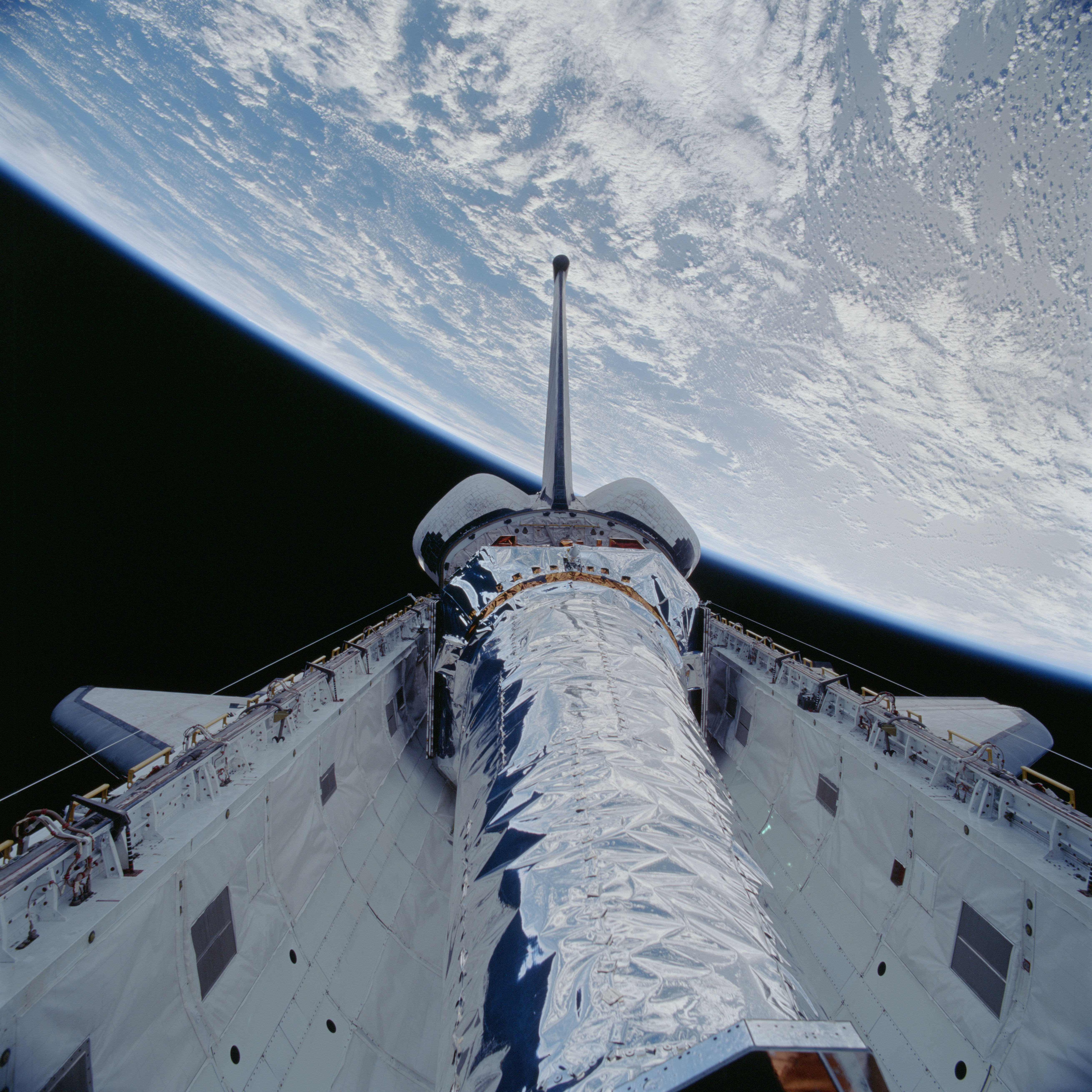
STS-93 in orbit. | Credit: NASA
Once all was said and done, the Shuttle reached orbit, shutting down the engines only 4.6m/s (10.3mph) short of its target velocity.
Certainly a close one.
Gemini 8
I am aware that this article has thus far given the impression that malfunctions occur primarily during launch.
While launch is arguably the most dangerous phase of a mission, something can go wrong at any time. We only need to cast our minds back to March 16th 1966 to find one such example.
Neil Armstrong, prior to becoming humanity’s first moonwalker, was better known among the United States Air Force as a test pilot. A veteran of 7 X-15 flights, Armstrong was recruited into NASA’s astronaut corps in time for the Gemini missions; designed to test the technology and techniques for an eventual manner lunar program.

Neil Armstrong with an X-15 rocket plane. | Credit: NASA
Armstrong was eventually selected to head up Gemini 8 alongside fellow astronaut David Scott. What was supposed to be a 3 day mission to accomplish the first in-space docking turned into a dizzying death trap that could have easily ended in tragedy.
Gemini 8’s launch aboard the Titan II launch vehicle went about as smoothly as one could ask for, as did the rendezvous with their Agena target vehicle. You’d be forgiven for thinking that NASA had this whole thing figured out.
Docking, however, is when things went off-nominal.
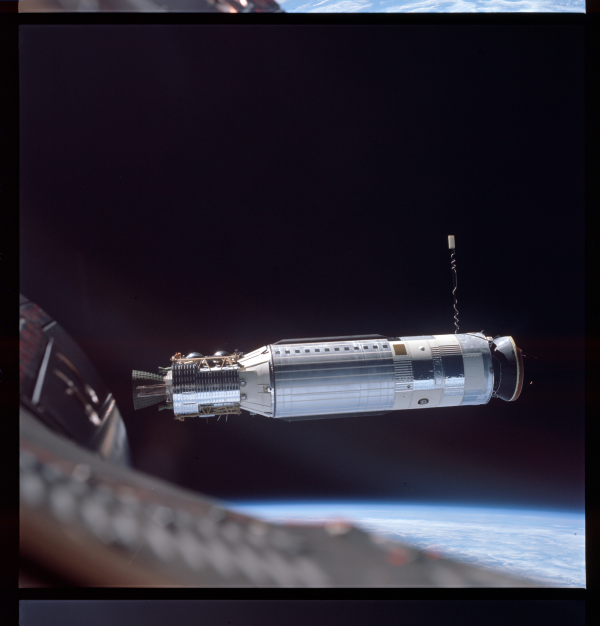
The Agena target vehicle as seen from Gemini 8. | Credit: NASA
Shortly after accomplishing their first docking, while attempting to manoeuvre their now-conjoined vehicles, Scott noticed that they were in a roll. Suspecting the Agena to be the culprit, Scott decoupled the Gemini from the Agena, and Armstrong quickly backed away from it.
They kept rolling.
Without the added mass of the Agena, Scott and Armstrong’s Gemini spacecraft only accelerated its rotation. Both astronauts would be subjected to upwards of 1 rotation a second before they could regain control. In the midst of such a disorienting experience, Armstrong was able to disarm the orbital maneuvering system and correct the spin using the Gemini’s re-entry thrusters.
A faulty thruster was to blame.
The mission was cut short as the incident raised safety concerns, and much of the fuel was depleted, which prevented the astronauts from completing the rest of their objectives. Thankfully, they both returned to Earth safely.

Gemini 8 going for a swim… | Credit: NASA
In Conclusion…
Space travel is risky business. I hope these examples have given you an insight into the kinds of trials and tribulations that astronauts can face in their quest to discover.
From engine leaks and staging issues, to being spun around like a ragdoll in the lonely expanse, astronauts have to train for every possible eventuality. It is one of the reasons they have my eternal respect.
See you next week!
 Weekly Voyager
Leave a comment