

A H-IIA rocket before launch. | Credit: Kyodo
Reliable Space Access
Every space-faring country has a workhorse rocket, in my view.
For the United States, Falcon 9 currently fills that space. China has the Long March family of rockets. Russia has been launching satellites (and people) into space for decades using the Soyuz rocket.
Japan has the H-IIA.
Designed as the successor to the H-II, the H-IIA has been carrying out its multi-decade assignment mostly under the radar. This plucky space-farer hasn’t really captured the imagination of the space enthusiast community in the way that more iconic vehicles like Soyuz or Falcon 9 have, which I think is a shame. H-IIA has a number of important accomplishments and spaceflight “firsts” under its belt, so today I want to give it some love.
A Leap Forward
H-IIA, from a technological perspective, may be a little bit antiquated when compared to the likes of Falcon 9 or Electron. For the time, however, it was a great accomplishment for Japan’s national efforts in spaceflight.
Arguably the biggest leap forward in this regard is the staged-combustion cycle LE-7A engine, which derives from the H-II’s LE-7 engine. Japan’s first fully domestically produced rocket engine, the LE-7 initially faced performance setbacks and failures, which marred an otherwise fairly successful launch program.
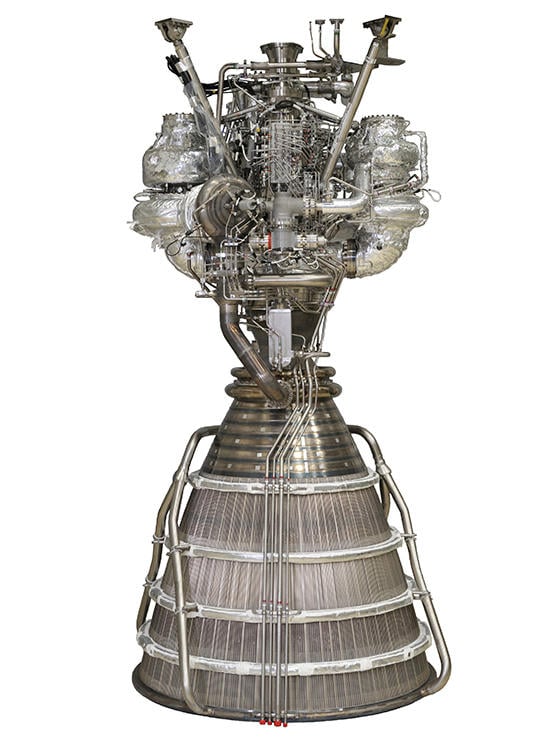
An LE-7A engine. | Credit: Mitsubishi Heavy Industries
LE-7A took the learnings from these failures and has since grown to become a highly reliable engine. Upgrades included welding reduction via casting/machining more components, and redesigning components in order to make the design simpler and therefore more reliable.
Reliable it became!
Since initially flying on the H-IIA in 2001, the LE-7A engine has not experienced any critical failures during its 40+ mission history. Impressive in this writers humble opinion.
The H-IIA also sports a second stage engine with heritage that is just as significant. Designated LE-5B, this engine has also performed its duties admirably as a reliable rocket engine for Japan’s space ambitions. It also shares some of the LE-7’s DNA with regard to being a technological leap for Japan’s rocket design.
The LE-5B shares its heritage with the LE-5A, which was the worlds first operational expander bleed cycle rocket engine. Those of you who read my article about rocket engine cycles may have a general idea of what a cycle is, but for those uninitiated, an engine spins pumps by sending hot gas through a turbine. In the expander bleed cycle, this gas was generated by passing fuel through the nozzle and combustion chamber walls, heating it to a sufficient level such that it changes state.
As a descendant of the LE-5A, the LE-5B sports upgrades aiming for simplification, the main of which involved feeding the fuel around only the combustion chamber walls, omitting the nozzle. Such upgrades harmed the efficiency of the engine, but benefits in cost and reliability were seen as worthy trade-offs, and it seems that this worked as versions of the LE-5B are still in use on H-IIA today.
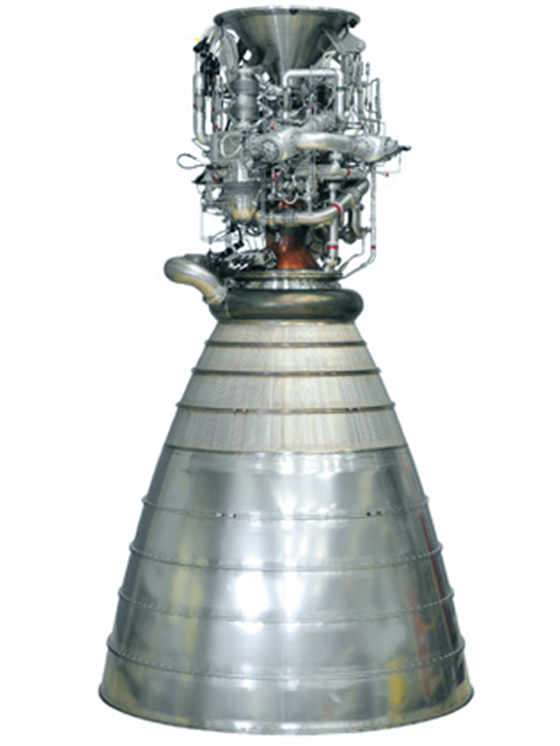
An LE-5B engine. | Credit: Mitsubishi Heavy Industries
A Series of Successes
H-IIA has, since its debut, launched a number of notable missions.
Hayabusa2 is arguably the most notable mission that H-IIA has launched. A successor to Hayabusa, the world’s first asteroid sample return mission, Hayabusa2 aimed to recapture the success of its predecessor. Rendezvousing with asteroid 162173 Ryugu in 2018, Hayabusa2 successfully returned more asteroid samples to Earth two years later in 2020. Since then, Hayabusa2 has had its mission extended, aiming to return yet more samples from another asteroid (1998 KY26).

Asteroid 162173 Ryugu. | Credit: JAXA
H-IIA has also been contracted by other nations in order to serve their space ambitions. Launching in 2020, the Emirates Mars Mission does what it says on the tin. UAE’s first Mars satellite reached the red planet in 2021, making it the first satellite from the Arab world to reach Mars, and making the UAE the fifth country to reach this outer world. It has since conducted observations on Martian weather patterns and climate change.
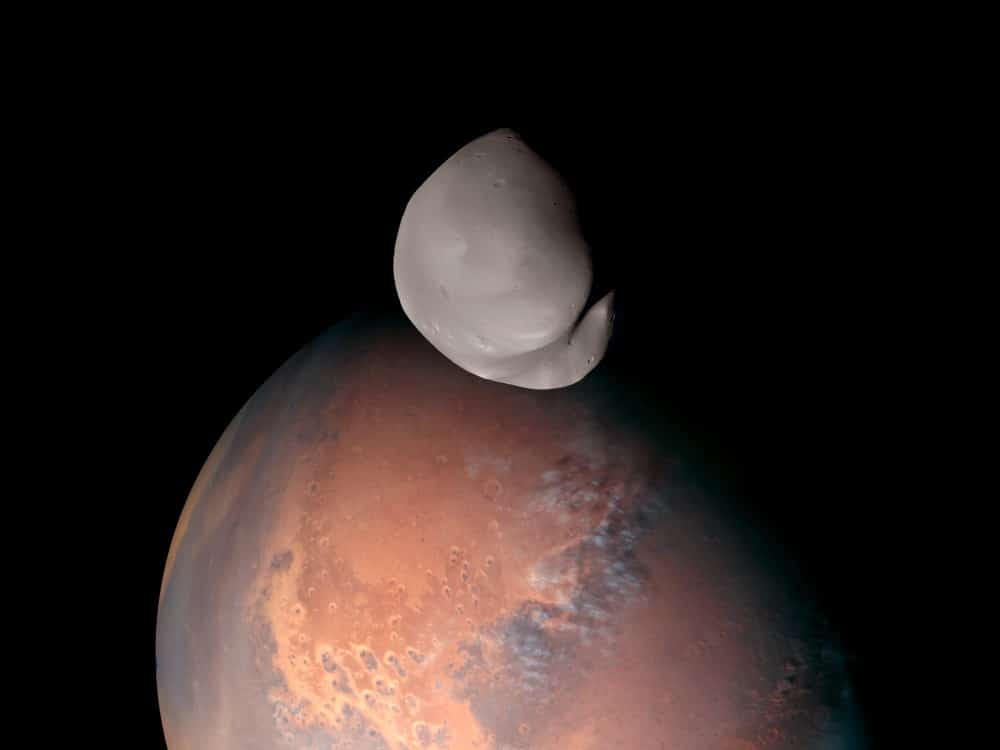
Mars and its moon Deimos as seen from Emirates Mars Mission. | Credit: UAE Space Agency
In more recent years, H-IIA has also helped Japan reach the lunar surface. The SLIM (Smart Lander for Investigating Moon) lander was launched in 2023 and subsequently made Japan the fifth country to conduct a soft landing on the lunar surface. SLIM is also notable for breaking records in longevity for landers without RTG power generators. Finally, the novel design of the rovers also deployed by SLIM are worth a mention. They’re very cute little guys.

One of the small rovers deployed by SLIM. | Credit: JAXA
I’m Off…
This’ll be the last article for the next few weeks as I’m off to Japan for a holiday. As you may have suspected, this article was inspired by my destination. Hopefully you found this brief look at an underappreciated rocket interesting.
See you when I return!
 Weekly Voyager
Leave a comment