

Perseverance rover takes a selfie on the surface of Mars. Price tag: $2.4 billion. | Credit: NASA
Internet Arguments
In an effort to expand the readership of this website, I have taken to X to promote the articles, share space content that I find inspiring and partake in discussions around this area of human endeavour.
While browsing some accounts that share amazing posts, such as Don Pettit’s space photography and Interstellar Gateway’s Starship content, you’ll inevitably come across detractors. Typically criticism takes the shape of misinformed or deliberately misleading statements about how SpaceX is always blowing up rockets, or how space travel doesn’t benefit anyone and that we have enough problems to worry about on Earth.
I spend a little time trying to politely correct such statements, and typically the community notes feature on X does a good job of providing corrections and additional context. Unfortunately, this sentiment appears to be fairly prevalent amongst laypeople in particular, who don’t follow spaceflight outside of the occasional headline. It’s a compelling argument on the face of it. We have so many challenges on Earth, why spend that money on space exploration?
This article will attempt to put to bed such criticism by sharing the benefits of the final frontier, and how this technology can actually help us tackle the challenges of the 21st century.

Pretty much me. | Credit: XKCD
The Obvious Stuff
To start off this journey of discovery, I figured that there’s some fairly obvious benefits to space exploration that most people tend to forget.
Some nostalgic memories for me involve sitting in the back of my dad’s car as a child and listening to whatever novelty voice pack was installed onto the sat nav. I distinctly remember the delight of having Yoda telling us to take the second exit at the next roundabout, or Austin Powers telling us “you’ve reached your destination. Groovy baby! Yeah!”
Point is, that entertainment, and more importantly, the directions it provided us, would not have been possible without a sat nav. If you hadn’t of guessed already, a sat nav, as the name suggests, uses satellite navigation to direct you to the destination of your choice. How space funding is related to this should be painfully obvious.
Satellites also provide us with a plethora of other benefits. The climate conscious among you may scoff at the idea of rockets launching things into space, but Earth observation satellites work 24/7 to track weather patterns, measure sea temperatures and monitor Antarctic ice shelves. Without this vital infrastructure, the degree to which we can understand and combat climate change and its effects would be utterly neutered.
Finally, some of the readers here may even be using satellites to access this very page. SpaceX’s Starlink is a recent development in using satellite technology to enhance communication on Earth. By providing satellite access to the internet, Starlink is able to provide online access to parts of the world that were otherwise cut off. This is extremely useful for those who live in remote areas, or even for soldiers, as evidenced by Starlink’s use in the Ukraine war. Amazon’s Kuiper satellite system promises to achieve similar results, giving rise to competition in a new ring of internet service providers.

Starlink satellites being deployed. | Credit: SpaceX
Diffusion of Innovation
The above examples are pretty cut and dry with regards to how space exploration is beneficial. After all, they’re literally satellites in space. Our pursuit into the black has also produced some pretty neat technology along the way that, on the surface, has no relation to space whatsoever. Ever had laser eye surgery? Have you got one of those little handheld vacuum cleaners? Ever slept on a memory foam mattress? You got space exploration to thank for all of these, and more!
Technology is never developed in isolation. We always, as a species, find a use for something, even if it’s not the intended purpose. Take the laser eye surgery example from earlier. Developments in laser technology for spacecraft docking systems found its way into opticians everywhere. New uses can be found for cutting edge tech, and the descendants of technology originally developed for space travel find themselves serving other purposes elsewhere.
Smaller components for lightweight handheld devices found their way into those handheld vacuums, and NASA’s research into aircraft crash protection systems birthed the memory foam we all know and love.
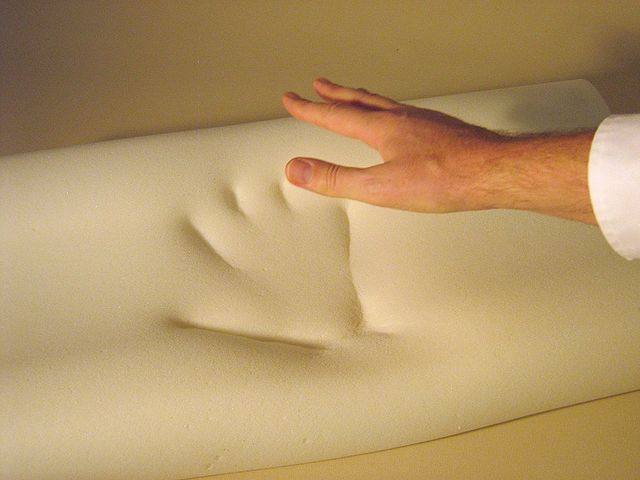
A good night’s sleep, courtesy of NASA. | Credit: Wikipedia
Other examples include:
- LED therapy – researched by NASA to stimulate plant growth in space. Now used for dermatological purposes.
- Solar panels – Crucial power generation for spacecraft. Made more lightweight and efficient by the necessity for space applications.
- Freeze dried food – Developments by NASA in freeze dried food for astronauts improved nutrition retention.
- Safety Grooving – Initially developed by NASA to make aircraft and Space Shuttle landings safer. Now used to prevent road accidents.
- Mylar Blankets – Found in emergency kits everywhere, initially developed by NASA to help reflect radiated heat in space.
- Shock Absorbers – Developments by NASA into shock absorbers for launch towers now keep skyscrapers safe in earthquakes.
- Aircraft anti-icing technology – Developed by NASA to remove ice from aircraft wings.
- Scratch resistant visors – Developed by NASA to prevent scratches to space suit helmets. Now used in glasses and safety goggles.
The list could go on, but I think you get the idea. Space exploration gives us a reason to research these new technologies; new uses for them back on Earth make our lives easier and help those less fortunate in many different ways.

Even man’s best friend benefits! | Credit: Nature’s Variety
Deal or no deal?
Of course, there is a cost to all this research. Spaceflight is expensive, after all, but what does it actually cost the average person?
Lets start off with the Americans, as NASA is the most recognised agency worldwide.
Firstly, it’s worth noting that the benefits listed above didn’t cost you anything if you aren’t a US taxpayer. That’s $0.00 if you aren’t paying taxes in the United States.
For an American taxpayer however, we can do some napkin math.
In 2022, there were 153.8 million filed tax returns, and NASAs budget for that year was $24.04 billion. A simple division means that on average, NASA cost each taxpayer a whopping…
Drum roll please…
$156.30 per year.
Using the same math we can determine the 2022 US national defence budget costs the average taxpayer $5056.56 per year.
Ridiculous.
Of course, you’ll be paying more or less tax depending on income, but proportionally speaking the US taxpayer spends 30x more on their military than they spend on NASA.

2011 statistics for the US national defence budget, compared to science spending. | Credit: Steve Haroz
Just for a little more perspective, the total government spending on space programs worldwide in 2024 was equivalent to $135 billion. That means Elon Musk has more than double the net worth of the entire world’s governmental space travel expenditure.
I’ll leave it up to the reader to determine if that’s a good thing or not. I don’t get political here!
My point, hopefully made clear here, is that space exploration is, in my opinion, woefully underfunded. Imagine what would be possible if we committed ourselves (financially) as a species to exploring the stars…
Oh well.
Putting a Price on Knowledge.
Amongst all this debate online, and in person, about the value proposition of space exploration, I feel that something has been lost.
What price would you put on expanding your knowledge?
Space travel has revealed to us the terrifying power of black holes, the beauty of distant nebulae and exoplanets that may harbour life. Most importantly to me, space exploration ignited my innate human desire to just know. No amount of money in the world would be too much in exchange for knowledge about our place in the universe.
How can we lose such curiosity?
According to the current public attitude towards spaceflight, that might just be me.
I’d like to drive this point home, and end on a quote by late US president John F. Kennedy:
“But why, some say, the Moon? Why choose this as our goal? And they may well ask, why climb the highest mountain? Why, 35 years ago, fly the Atlantic? Why does Rice play Texas? We choose to go to the Moon. We choose to go to the Moon… We choose to go to the Moon in this decade and do the other things, not because they are easy, but because they are hard.”

“Task Accomplished” – July 1969. | Credit: NASA
See you next week!
 Weekly Voyager
Leave a comment